


Every constituency has different needs and priorities. A candidate campaigning in a coastal fishing area must address issues that matter to fishermen, while a candidate in an urban IT hub needs to focus on concerns like jobs, technology, and infrastructure. Even if these places are only a few hundred kilometers apart, the voters care about different things. That’s why using the same campaign message across an entire district often fails to connect with people. Tailoring the message to each constituency is far more effective.
Micro-targeting solves this problem. Instead of broadcasting one message to everyone, it breaks a constituency down into smaller voter segments based on the issues that actually matter to them, and then delivers tailored content to each group through social media. Done correctly, this approach doesn’t just improve engagement metrics; it changes how voters perceive whether a candidate understands their ward, their village, or their neighborhood.
What Micro-Targeting Actually Means in a Political Context
Micro-targeting is more than just showing ads based on age or gender. In political campaigns, it means understanding different groups of voters within the same constituency and the issues that matter most to them.
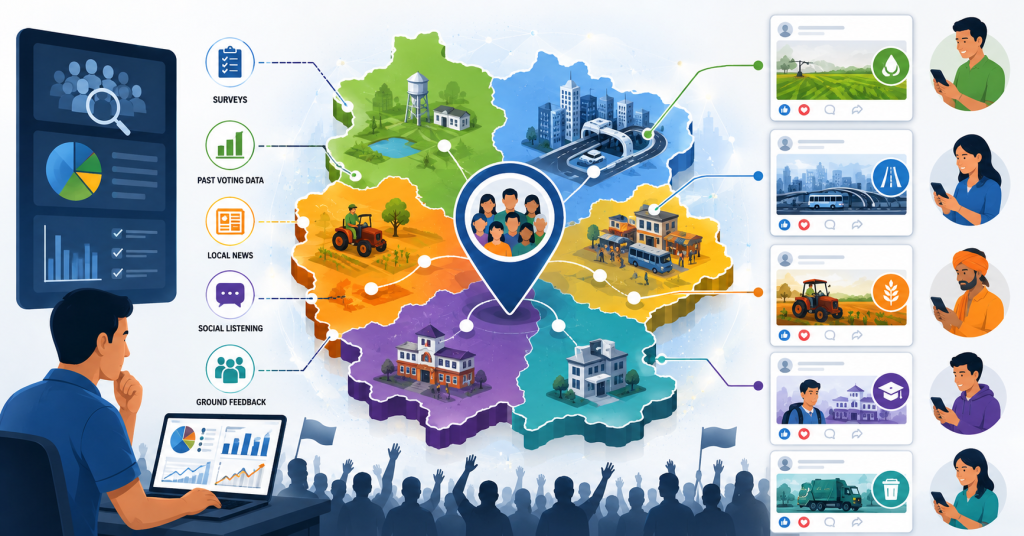
For example, one area may struggle with water shortages, another may need better roads, a third may have high youth unemployment, while another may be affected by land acquisition problems.
The idea is simple: match the campaign message to the local issue. Voters in drought-prone areas should see messages about water supply and irrigation. People living in busy urban neighborhoods should see content about traffic, waste management, and better infrastructure.
Even though these voters are part of the same constituency, their concerns are different. Showing everyone the same campaign message is less effective than delivering content that speaks directly to local needs.
Why Constituency-Level Segmentation Works Better Than Broad Targeting
Generic campaign messages often fail to connect with voters. Phrases like “development for all” or “we will bring change” are used so often that many people simply ignore them. In contrast, messages that focus on local issues feel more relevant and believable.
Here are three reasons why constituency-level segmentation works better:
1. Local issues grab attention.
People are more likely to engage with content that talks about problems they face every day. A post about a damaged road, water shortage, poor schools, or delayed public services will usually get more likes, comments, and shares than a general campaign slogan because it feels personal.
2. It builds trust.
Voters want representatives who understand their neighborhood and its problems. When a candidate talks about the specific issues in a village, ward, or booth, it shows they are connected to the community and aware of what people are going through.
3. It makes better use of campaign budgets.
Political campaigns have limited advertising budgets. Showing the same message to everyone wastes money because not every voter has the same concerns. By targeting different areas with messages that match local issues, campaigns can improve engagement, attract more supporters, and encourage more people to vote.
Building the Segments: Where to Start
Before launching any political campaign, you first need to understand the different issues that matter across the constituency. This is a research process, not a creative one.
Campaign teams can gather information from several sources, including:
- Booth-level surveys conducted by volunteers or party workers
- Previous election results and voter turnout data for each ward or polling booth
- Local newspapers and regional news to identify common public concerns
- Social media platforms like Facebook, Instagram, and X to understand what people are discussing
- Feedback collected during door-to-door campaigns, public meetings, and town halls
After collecting this information, divide the constituency into groups based on the issues people care about.
For example:
- A rural area may focus on farmer income, irrigation, and minimum support prices (MSP).
- An urban area may be more concerned about housing costs, traffic, public transport, and civic services.
- A semi-urban area may have a mix of both rural and urban issues, so the campaign message should address both.
By creating these issue-based segments, political campaigns can deliver messages that are more relevant and meaningful to each group of voters.
Turning Segments Into Social Media Campaigns
Once issue clusters are defined, each one needs its own content and ad strategy. This is where the actual micro-targeting happens on platforms like Facebook, Instagram, and WhatsApp.
Custom audiences by geography. Facebook and Instagram allow ad targeting down to a radius around a specific location, which can be mapped to polling booths or panchayat boundaries. Combined with demographic filters, this lets a campaign show water-scarcity content only to users physically located in the affected blocks.
Issue-specific creative. Each cluster should get its own set of posts, reels, or short videos, in the local language and dialect where relevant. A message about industrial job creation for a youth-heavy urban segment should look and sound completely different from a message about crop insurance for an agrarian segment, even if both are promoting the same candidate.
Sequential messaging. Rather than a single ad, effective micro-targeting uses a sequence: an awareness post introducing the issue, a follow-up post showing the candidate’s stance or track record on it, and a final call-to-action post around voter registration, a rally, or election day turnout. This mirrors how a conversation naturally builds trust, rather than a one-off pitch.
WhatsApp for hyperlocal reach. In many Indian constituencies, WhatsApp groups organized by village, ward, or community remain one of the most effective channels for issue-specific updates, especially where internet penetration or platform preference limits reach on Facebook and Instagram. Voice notes and short videos in the local language tend to outperform text messages here.
Measuring What's Working
Micro-targeting only pays off if a campaign tracks performance at the segment level, not just overall reach. Useful metrics include:
- Engagement rate by issue cluster (comments, shares, saves)
- Video completion rate for issue-specific reels
- Click-through rate on location-based ads
- Volunteer sign-ups or event RSVPs generated per segment
- Sentiment in comments — is the response supportive, neutral, or hostile
Campaigns that review this data weekly can reallocate budget toward the segments and issues generating real engagement, and revise messaging in clusters that are underperforming, well before election day.
Common Mistakes to Avoid
1. Creating too many segments
Dividing a constituency into 15 or more small groups may seem like a smart idea, but it only works if your team can create good content for every group. If you don’t have enough time or resources, the content becomes repetitive and less effective. Start with three or four well-researched segments and expand only when your team can handle it.
2. Assuming voters care about only one issue
Most voters have more than one concern. For example, a young person living in a city may care about both jobs and better roads or public transport. Treat segments as a way to understand voters, not as fixed categories. Your messaging should be flexible enough to address multiple concerns.
3. Using generic images and videos
Local campaigns work best when they feel authentic. Avoid using stock photos or generic videos that could belong anywhere. Instead, use real photos of local landmarks, neighborhoods, people, and local language. This helps voters feel that the campaign truly understands their community.
4. Ignoring political advertising rules
If you’re running political ads on platforms like Meta, make sure your campaign follows all required authorization and disclosure rules. During elections, you should also comply with the Election Commission’s guidelines and the Model Code of Conduct. Setting up these requirements early helps avoid problems later.
Micro-targeting based on constituency issues is not about running more ads—it’s about showing the right message to the right voters at the right time. When campaign messages focus on the issues that matter most to each area, they are more likely to capture attention, build trust, and encourage voter engagement.
This approach requires careful research, well-planned content for different voter segments, and continuous performance tracking. The result is a campaign that feels connected to every part of the constituency instead of relying on one generic message for everyone.
At Osumare Marketing Solutions, we help political campaigns turn ground-level insights into effective digital strategies. By combining voter research, audience segmentation, localized creatives, and platform-specific ad management, we create campaigns that speak to the unique concerns of each constituency. Instead of treating digital marketing and political strategy as separate efforts, we bring them together to help candidates connect with voters in a more meaningful and measurable way.