


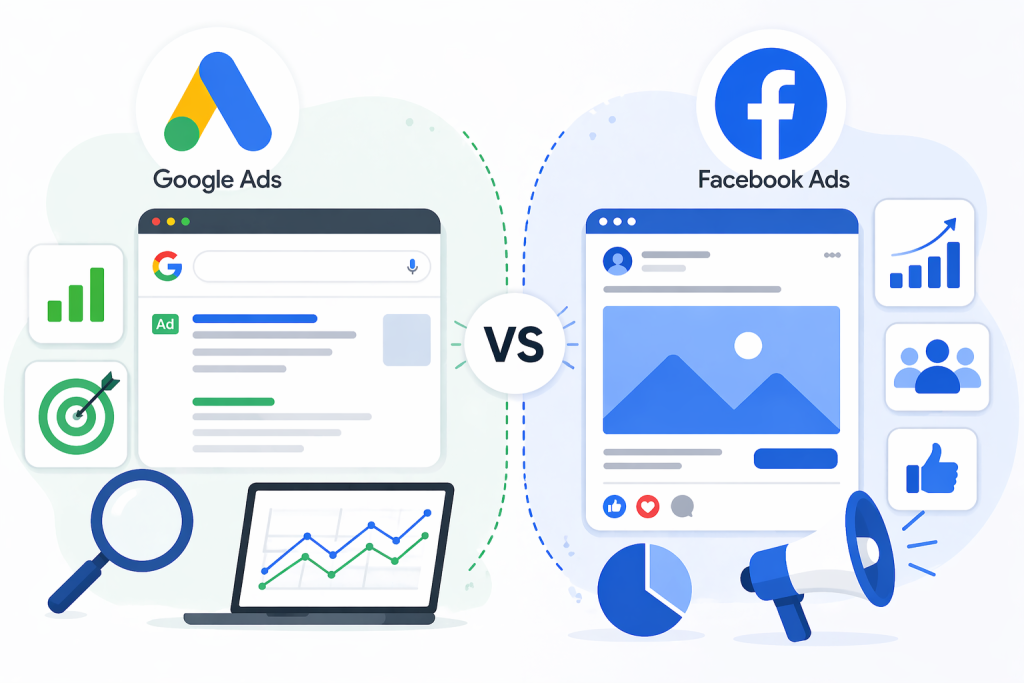
In today’s digital-first world, advertising has become the backbone of business growth. Whether you are a startup, a local shop owner, or an established brand, reaching your audience online is no longer optional—it’s essential. Among the most powerful advertising platforms available today are Meta Ads and Google Ads. Both platforms dominate the digital advertising space, but they work in very different ways.
If you’ve ever wondered which one is better for your business, the answer is not as simple as choosing one over the other. It depends on your goals, audience, budget, and marketing strategy. In this blog, we will explore both platforms in detail, compare their strengths and weaknesses, and help you decide which one suits your business best.
Understanding Meta Ads
Meta Ads refer to advertising across platforms owned by Meta, including Facebook, Instagram, Messenger, and Audience Network. These platforms have billions of active users, making them ideal for reaching a wide and diverse audience.
Meta Ads are primarily based on user interests, behaviors, and demographics. This means you can target people even if they are not actively searching for your product or service.
For example, if you are selling fitness products, Meta can show your ads to people who follow fitness pages, engage with gym content, or have shown interest in health-related topics.
Key Features of Meta Ads
One of the biggest strengths of Meta Ads is its advanced targeting capabilities. You can target users based on age, gender, location, interests, online behavior, and even life events.
Another powerful feature is visual storytelling. Platforms like Instagram and Facebook allow you to create visually appealing ads using images, videos, reels, and carousel formats. This makes Meta Ads highly effective for brand building and engagement.
Meta Ads also offer remarketing capabilities, allowing you to reconnect with users who have previously interacted with your business. For example, if someone visited your website but didn’t make a purchase, you can show them ads again to encourage conversion.
Understanding Google Ads
Google Ads, on the other hand, works on a completely different principle. It is primarily based on intent. This means your ads are shown to users who are actively searching for something on Google.
For example, if someone searches for “best digital marketing course near me,” Google Ads can display your ad at the top of the search results.
Google Ads includes multiple advertising formats such as Search Ads, Display Ads, YouTube Ads, and Shopping Ads.
Key Features of Google Ads
The biggest advantage of Google Ads is high purchase intent. When users search for something, they are already interested or ready to take action. This makes Google Ads highly effective for generating leads and sales.
Another important feature is keyword targeting. You can choose specific keywords related to your business and show ads when users search for those terms.
Google Ads also offers measurable results. You can track clicks, conversions, cost-per-click (CPC), and return on investment (ROI) in detail.
Core Difference: Intent vs Discovery
The fundamental difference between Meta Ads and Google Ads lies in how users interact with them.
Meta Ads focus on discovery. Users are browsing social media, not actively looking to buy something. Your ad interrupts their scrolling and introduces your product or service.
Google Ads focus on intent. Users are actively searching for something. Your ad appears as a solution to their problem.
This difference is crucial because it affects how you design your campaigns and what results you can expect
When Meta Ads Work Best
Meta Ads are highly effective in certain situations. If your goal is to build brand awareness, Meta is one of the best platforms available.
For example, if you are launching a new product or starting a new business, Meta Ads can help you reach a large audience quickly and create awareness.
Meta Ads are also great for engagement and community building. If you want people to follow your brand, like your content, or interact with your posts, social media platforms are ideal.
Another strong use case is visual products. Businesses like fashion, food, travel, fitness, and lifestyle brands perform exceptionally well on Meta because they rely heavily on visuals.
Meta Ads are also powerful for remarketing. You can target users who have already visited your website or interacted with your brand, increasing the chances of conversion.
When Google Ads Work Best
Google Ads shine when your goal is to generate leads or sales quickly.
If someone is searching for “buy laptop online” or “best dentist near me,” they already have a strong intent to take action. Google Ads allows you to capture this demand instantly.
Google Ads are especially effective for:
- Local businesses (restaurants, clinics, service providers)
- E-commerce stores
- Professional services (lawyers, consultants, agencies)
Another advantage is that Google Ads can deliver fast results. Unlike Meta Ads, where you may need time to build awareness, Google Ads can start generating traffic and leads almost immediately.
Cost Comparison: Which is More Affordable?
Cost is one of the biggest concerns for businesses when choosing between Meta Ads and Google Ads.
Meta Ads generally have a lower cost per click (CPC) compared to Google Ads. This makes them suitable for businesses with smaller budgets.
However, lower cost does not always mean better results. Since Meta Ads target users who are not actively searching, conversion rates may be lower.
Google Ads, on the other hand, usually have a higher CPC, especially for competitive keywords. But the conversion rate is often higher because users already have intent.
So, the real comparison is not about cost alone—it’s about cost vs return on investment (ROI).
Targeting Capabilities
Both platforms offer advanced targeting, but they differ in approach.
Meta Ads allow you to target users based on:
- Interests
- Behaviors
- Demographics
- Custom audiences
- Lookalike audiences
This makes Meta Ads highly effective for reaching new audiences.
Google Ads target users based on:
- Keywords
- Search intent
- Location
- Device
- Audience segments
This makes Google Ads more precise when it comes to capturing demand.
Ad Formats and Creativity
Meta Ads excel in creative formats. You can use images, videos, reels, stories, and interactive content to engage users.
This gives you more freedom to experiment and create emotionally appealing campaigns.
Google Ads, especially Search Ads, are more text-focused. While Display and YouTube Ads allow visuals, the core strength of Google Ads lies in delivering the right message at the right time.
If your business depends on strong visuals and storytelling, Meta Ads may be more suitable.
Conversion Funnel Strategy
A smart marketer does not choose one platform over the other—they use both strategically.
Meta Ads are ideal for the top of the funnel, where you create awareness and attract potential customers.
Google Ads are ideal for the bottom of the funnel, where users are ready to take action.
For example:
- Use Meta Ads to introduce your brand
- Retarget interested users on Meta
- Capture high-intent users through Google Ads
This combination creates a powerful marketing funnel that maximizes results.
Real-Life Example
Let’s say you run a fitness coaching business.
With Meta Ads, you can:
- Show transformation videos
- Share client success stories
- Target people interested in fitness
With Google Ads, you can:
- Target keywords like “online fitness coach”
- Capture users ready to sign up
Using both platforms together increases your chances of success.
Which One Should You Choose?
The honest answer is: it depends on your business goals.
Choose Meta Ads if:
- You want to build brand awareness
- You have visually appealing products
- You want to engage with your audience
- You are working with a limited budget
Choose Google Ads if:
- You want immediate leads or sales
- Your audience is actively searching for your service
- You have a higher budget for competitive keywords
- You want measurable and quick ROI
Final Verdict
There is no universal winner between Meta Ads and Google Ads. Both platforms are powerful in their own ways.
Meta Ads help you create demand, while Google Ads help you capture demand.
If you are serious about growing your business, the best strategy is to use both platforms together. This allows you to reach your audience at every stage of their journey—from discovery to conversion.
In the end, success in digital advertising is not about choosing the “best” platform. It’s about understanding your audience, setting clear goals, and using the right tools strategically.