


What Is EEAT in SEO?
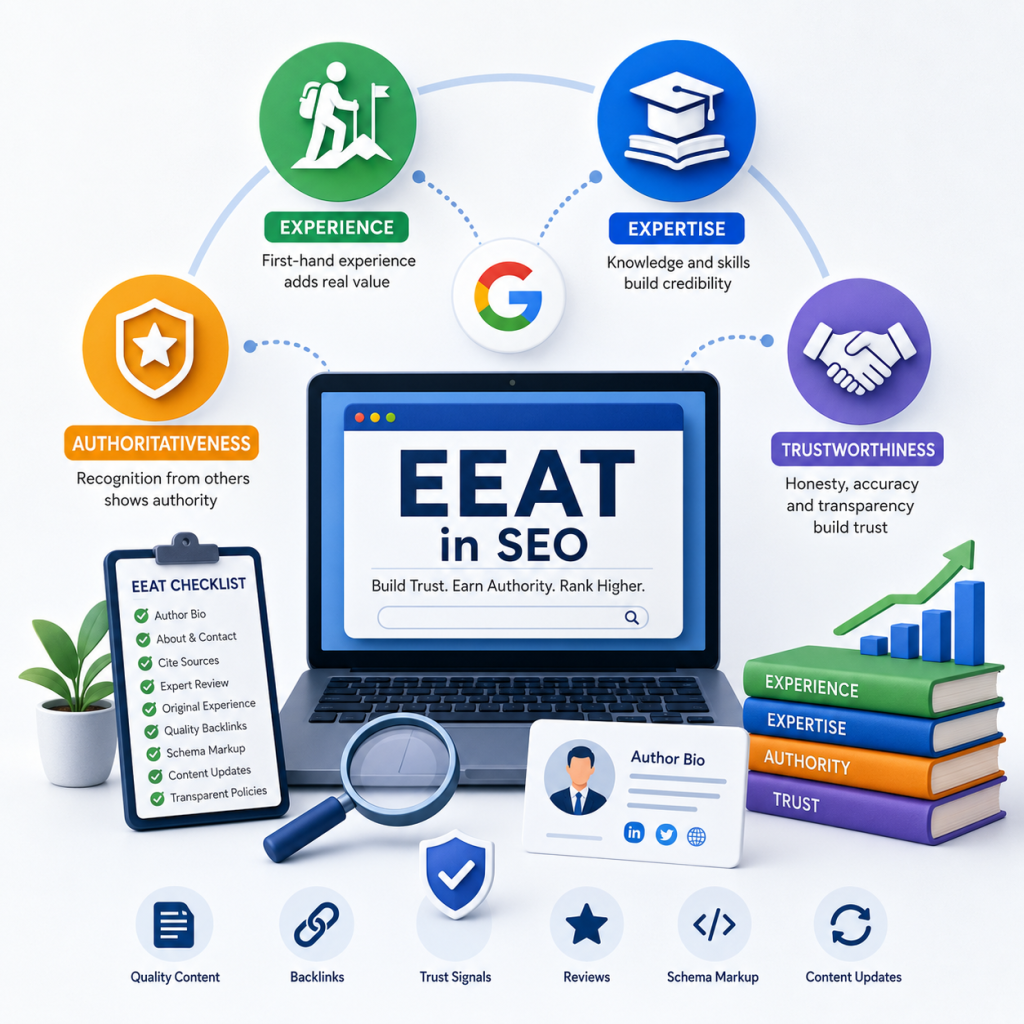
EEAT stands for Experience, Expertise, Authoritativeness, and Trustworthiness. It’s a framework Google’s Search Quality Raters use to judge whether content deserves to rank well — especially content that could affect a person’s health, money, safety, or well-being.
EEAT is not a direct ranking factor you can “turn on.” Instead, it’s a concept baked into Google’s algorithms through hundreds of smaller signals: who wrote the content, whether they know what they’re talking about, whether other trusted sources vouch for the site, and whether the content is accurate and safe to rely on.
Google added the extra “E” (Experience) in December 2022, upgrading the older E-A-T model. The change reflects a simple idea: expertise from textbooks is good, but firsthand experience — actually using a product, visiting a place, living through a situation — often produces more useful, trustworthy content.
Why EEAT Matters More Than Ever
Three forces have pushed EEAT to the center of SEO strategy:
- AI-generated content flooded the web. Anyone can now produce thousands of articles in a day. Google needs a way to separate genuinely useful content from mass-produced filler.
- YMYL topics carry real-world risk. “Your Money or Your Life” pages — medical advice, financial guidance, legal information — can cause real harm if wrong. Google holds these to a much higher EEAT bar.
- Google’s Helpful Content System rewards content created for people, not search engines, and EEAT signals help distinguish the two.
The Four Pillars of EEAT Explained
1. Experience
Has the creator actually used the product, visited the place, or lived the situation they’re writing about? Experience shows up as first-person details, original photos, specific numbers, and honest pros and cons that only come from hands-on use.
2. Expertise
Does the creator have the knowledge or skill to speak credibly on the topic? For technical or medical topics, this often means formal qualifications. For hobbyist or lifestyle topics, deep practical knowledge can count as expertise too.
3. Authoritativeness
Is the creator or website recognized as a go-to source on the topic? This is measured externally — through backlinks, mentions, citations, and reputation across the web, not just what the site says about itself.
4. Trustworthiness
Is the content accurate, honest, safe, and transparent? Trust is the most important pillar of the four — Google’s guidelines describe the other three as existing largely to build trust. A page with weak experience but strong trust can still perform reasonably; a page with strong expertise but no trust will struggle.
Beginner Level: Foundational EEAT Practices
If you’re just starting out, focus on these basics first.
- Add real author bios. Name the person who wrote the article, with a short bio explaining their relevant background.
- Create an About page. Explain who runs the site, its mission, and its qualifications.
- Add contact information. A visible email, contact form, or business address builds baseline trust.
- Cite sources. Link out to studies, official data, or authoritative references instead of making unsupported claims.
- Keep information accurate and current. Update outdated statistics, prices, or facts regularly.
- Use secure, professional site basics. HTTPS, no intrusive ads, clean design, and easy navigation all contribute to trust signals.
Intermediate Level: Building Expertise and Authority
Once the basics are covered, move on to strengthening your credibility signals.
- Showcase credentials clearly. For medical, legal, or financial content, display relevant certifications or licenses near the byline.
- Get expert review. Have a subject-matter expert review or co-sign content, and label it as “Reviewed by.”
- Build topical authority. Publish in-depth content across a cluster of related subtopics rather than one-off articles, showing you cover a subject comprehensively.
- Earn quality backlinks. Links from respected, relevant sites act as external votes of confidence.
- Collect and display reviews or testimonials. Genuine user feedback (with schema markup) supports trust signals.
- Maintain consistent NAP data. For local businesses, Name-Address-Phone consistency across the web reinforces legitimacy.
Advanced Level: Deep EEAT Optimization
At an advanced stage, EEAT becomes a strategic, ongoing program rather than a checklist.
Build a Genuine Author Entity
Google increasingly evaluates authors as entities across the web. Create consistent author profiles linked across your site, social platforms, and publications like LinkedIn or industry directories. Use Person schema markup connecting the author to their work.
Layer First-Hand Experience Signals
For product reviews, include original images, video, unboxing footage, or performance data you generated yourself. For service or travel content, include personal anecdotes, dates, and specific details that couldn’t be copied from another source.
Strengthen Digital PR and Off-Site Authority
Pursue mentions in industry publications, podcasts, interviews, and expert roundups. Authoritativeness is largely earned off-site — no amount of on-page tweaking substitutes for genuine third-party recognition.
Use Structured Data Strategically
Implement Organization, Person, Review, and FAQ schema to help search engines connect entities, credentials, and trust signals more precisely.
Conduct Regular Content Audits
Audit existing content for outdated claims, thin sections, or missing citations. Refresh or consolidate low-quality pages — Google’s Helpful Content guidance rewards sites that prune weak content rather than let it dilute the whole site’s trust profile.
Monitor Your Online Reputation
Track brand mentions, reviews, and sentiment across the web. Negative, unaddressed reputation issues can actively suppress rankings for YMYL sites, regardless of on-page optimization.
Align With E-E-A-T for AI-Generated Content
If AI tools assist your content production, ensure a knowledgeable human edits, fact-checks, and takes editorial responsibility for the final piece. Transparency about AI assistance, paired with human expert oversight, is becoming a trust differentiator.
A Quick EEAT Checklist
- Author name and bio on every article
- About and Contact pages present and detailed
- Sources cited for factual claims
- Content reviewed by a subject-matter expert (for YMYL topics)
- Original experience shown through images, data, or anecdotes
- Backlinks and mentions from reputable sites
- Schema markup for authors, reviews, and organization
- Regular content audits and updates
- Consistent author presence across platforms
- Transparent policies (privacy, editorial standards, corrections)
Final Thoughts
EEAT isn’t a plugin you install or a score you chase directly — it’s a reflection of whether your content genuinely deserves to be trusted. Start with the fundamentals of transparency and accuracy, layer in expertise and authority as you grow, and treat trust-building as a continuous practice rather than a one-time fix. Sites that do this consistently tend to perform well not just in Google’s eyes, but in their readers’ eyes too — which, ultimately, is the same goal.
At Osumare, this is exactly the philosophy we bring to every SEO strategy: build genuine trust first, and the rankings follow.