
Introduction
For more than two decades, SEO followed a simple rule: rank higher on Google and you’ll get more traffic.
Businesses invested in content, backlinks, technical SEO, and keyword research because reaching the first page—especially the #1 position—meant more visitors, leads, and sales. It was one of the most reliable ways to grow online.
Today, that rule is changing.
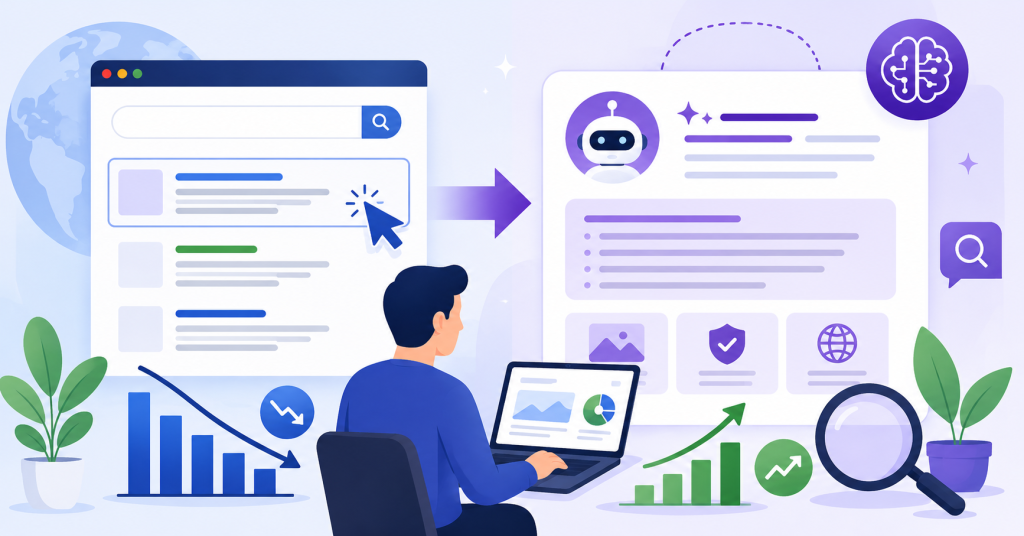
The rise of Google AI Overviews, ChatGPT Search, Microsoft Copilot, Perplexity AI, and other AI-powered search tools has completely changed how people search for information. Instead of showing only a list of websites, search engines are now providing complete answers directly on the search results page.
As a result, many users never visit a website.
If your website traffic has been decreasing even though your rankings haven’t changed much, you’re not imagining it. Businesses across industries are seeing the same trend.
This doesn’t mean SEO is dead. It simply means SEO is evolving, and businesses that adapt to this new reality will have a significant advantage over those still following old strategies.
Let’s understand what’s happening and, more importantly, what you can do about it.
The Rise of AI-Powered Search
Think about how you search today compared to a few years ago.
Earlier, if you searched for “What is SEO?”, Google displayed ten blue links. You opened two or three websites, compared information, and found your answer.
Today, the experience is very different.
Google often shows an AI Overview at the top of the page. ChatGPT can answer your question instantly. Microsoft Copilot and Perplexity AI also provide detailed responses without requiring you to visit multiple websites.
For users, this is convenient because they receive quick answers.
For businesses, however, it creates a new challenge.
Even if your content helped train or support that AI-generated answer, the user may never click on your website.
In other words, your content may still be valuable, but the traffic it once generated is shrinking.
What the Research Says
This isn’t just a theory. Several respected research organizations have studied how AI search is affecting website traffic, and the findings point in the same direction.
Ahrefs analyzed more than 300,000 search keywords before and after Google introduced AI Overviews. They found that when an AI Overview appears, the website ranking in the first position receives significantly fewer clicks than it did previously.
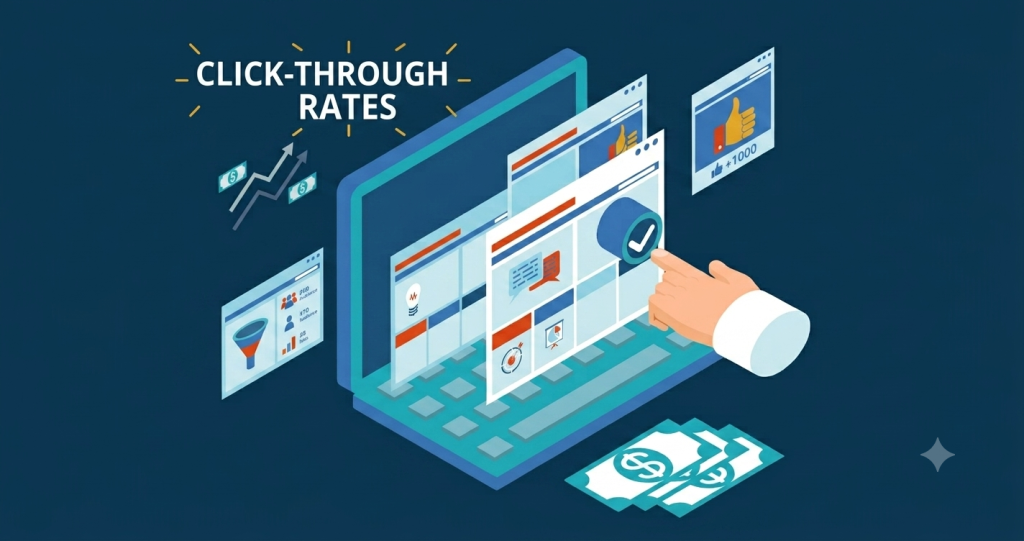
Pew Research reached a similar conclusion. Their study found that when Google displays an AI Overview, users click on traditional search results only about 8% of the time. Without an AI Overview, that number is closer to 15%. In simple terms, the likelihood of users clicking on websites is almost cut in half.
Publishers have also experienced this shift. According to data reported by Chartbeat, many news and publishing websites saw search traffic decline by nearly one-third during 2025.
Seer Interactive analyzed millions of search queries across different industries and observed similar declines in organic click-through rates. Interestingly, some industries started seeing slight improvements in early 2026, suggesting that search behaviour is beginning to stabilize.
While the exact percentages differ because each study measures different search scenarios, they all arrive at the same conclusion:
AI-generated answers are reducing the number of clicks websites receive from traditional search results.
Why Are Click-Through Rates Falling?
The answer is actually quite simple.
Google and AI-powered search tools are designed to answer questions immediately.
Imagine someone searches:
- What is Paint Protection Film?
- How does SEO work?
- Best time to visit Goa
- What is ceramic coating?
Earlier, users had to visit several websites to find these answers.
Now, AI provides a complete summary in seconds.
Since users already have the information they need, many don’t feel the need to click any website.
This behaviour is known as Zero-Click Search.
Interestingly, zero-click searches existed long before AI. Google already displayed weather forecasts, currency conversions, sports scores, maps, and featured snippets directly in search results.
AI Overviews have simply expanded this concept by answering much more complex questions.
This is why businesses are noticing fewer visitors even though their Google rankings remain stable.
Does This Mean SEO Is Dead?
Not at all.
Every few years, someone claims SEO is dead.
People said the same thing when Google introduced mobile-first indexing, voice search, featured snippets, and countless algorithm updates.
Yet SEO continued to evolve.
The same is happening today.
Instead of optimizing only for Google rankings, businesses now need to optimize for AI visibility.
The goal is no longer just appearing as the first blue link.
The goal is becoming the source that AI trusts enough to reference in its answers.
If your content is accurate, well-structured, trustworthy, and easy to understand, AI platforms are more likely to cite it.
And while citations may not generate as many clicks as traditional rankings once did, they significantly increase your brand’s visibility and credibility.
How Businesses Should Adapt Their SEO Strategy
The changing search landscape doesn’t mean businesses should stop investing in SEO. Instead, they should update their approach.
Create Content That Clearly Answers Questions
AI systems work best when content is organized and easy to understand.
Instead of writing long introductions before answering the user’s question, provide the answer early in the article.
Use descriptive headings, simple language, bullet points where appropriate, and short paragraphs.
For example, if your blog is about Paint Protection Film, explain what PPF is within the first few paragraphs before discussing its benefits or pricing.
This makes your content useful for both readers and AI systems.
Focus on Experience, Expertise, Authority, and Trust (E-E-A-T)
Google has emphasized E-E-A-T for years, and it’s becoming even more important with AI search.
Businesses should create content that demonstrates real experience rather than simply rewriting information available elsewhere.
Share customer case studies, before-and-after examples, original research, expert opinions, industry experience, and genuine insights.
For instance, a car detailing company explaining PPF installation using actual customer vehicles is far more valuable than copying generic information from other websites.
The more authentic your content is, the more likely AI systems are to trust and reference it.
Don't Depend Only on Google
Many businesses built their entire marketing strategy around organic search traffic.
That approach is becoming risky.
Successful businesses today generate visitors from multiple channels, including email marketing, LinkedIn, YouTube, Instagram, Facebook, WhatsApp communities, and referral partnerships.
If one source experiences a decline, the others continue bringing customers.
Diversifying your traffic sources makes your business more resilient in an AI-driven world.
Create Content AI Can't Replace
AI is excellent at answering simple informational questions.
However, it still struggles with highly local, personalized, or experience-based content.
People still visit websites when they want to compare products, read detailed reviews, check pricing, find local businesses, or make purchasing decisions.
For example, someone searching for “Best Paint Protection Film Studio in Pune” will likely compare customer reviews, pricing, photos, and service quality before making a decision.
This creates opportunities for businesses to produce content that goes beyond basic information.
Measure More Than Rankings
For years, marketers focused on keyword rankings.
Today, rankings tell only part of the story.
Businesses should also monitor whether they appear inside Google AI Overviews, ChatGPT Search, Perplexity AI, and other AI-powered platforms.
Several SEO tools are already introducing AI visibility reports because traditional rank tracking alone no longer reflects how users discover brands.
Success in SEO is increasingly about being visible wherever people search—not just on Google’s first page.
Build a Brand People Search For
One of the biggest advantages in the AI era is having a recognizable brand.
When users specifically search for your business name, AI summaries have less impact because users already know who they want to visit.
Building a strong brand requires consistent quality, positive customer reviews, social proof, public relations, educational content, and an active social media presence.
Brands that people remember receive direct searches, repeat visitors, and higher trust—all of which reduce dependence on generic search traffic.
The Future of SEO Is Bigger Than Google
SEO is no longer just about optimizing for search engines.
It’s about becoming the most trusted source of information across every platform where people ask questions.
Whether someone searches on Google, asks ChatGPT, uses Microsoft’s Copilot, or explores Perplexity AI, your business should aim to appear wherever answers are being delivered.
This requires creating genuinely helpful content instead of writing only for keywords.
Businesses that prioritize quality, expertise, and user experience will continue to grow, regardless of how search technology evolves.
Final Thoughts
AI-powered search is transforming digital marketing faster than many businesses expected.
Research from Ahrefs, Pew Research, Seer Interactive, and other industry leaders clearly shows that click-through rates are declining as AI-generated answers become more common. While the exact numbers vary, the trend is undeniable: users are increasingly getting the information they need without clicking through to websites.
However, this isn’t the end of SEO—it marks the beginning of a new chapter.
Success today isn’t measured only by ranking #1 on Google. It’s about creating trustworthy, experience-driven content that both people and AI platforms recognize as valuable. Businesses that invest in quality, build strong brands, diversify their traffic sources, and adapt to AI-driven search will continue to grow despite changing search behaviour.
At Osumare, we help businesses stay ahead of these changes by developing SEO strategies built for the modern search landscape. From improving website visibility and creating authoritative content to optimizing for AI-powered search experiences, our goal is to help brands reach customers wherever they search.
The search landscape will continue to evolve—but businesses that evolve with it will always stay one step ahead.