
Google has changed dramatically over the last few years. What was once a search engine designed primarily to direct users to websites has evolved into a platform that often provides answers directly on the search results page. Whether you’re searching for a definition, a recipe, a business address, or a detailed explanation of a topic, Google increasingly delivers the information without requiring users to click on a website.
This shift has led to the rise of zero-click searches, one of the biggest challenges and opportunities in modern SEO.
For businesses that rely on organic traffic, the concept can sound alarming. If users are getting answers directly from Google, how can websites continue attracting visitors? More importantly, how can brands generate leads, sales, and engagement when fewer people are clicking through to their content?
The reality is that SEO is not dying—it is evolving. Businesses that understand how zero-click searches work and adapt their content strategy accordingly can continue growing their visibility, authority, and traffic in the age of AI-powered search.
What Are Zero-Click Searches?
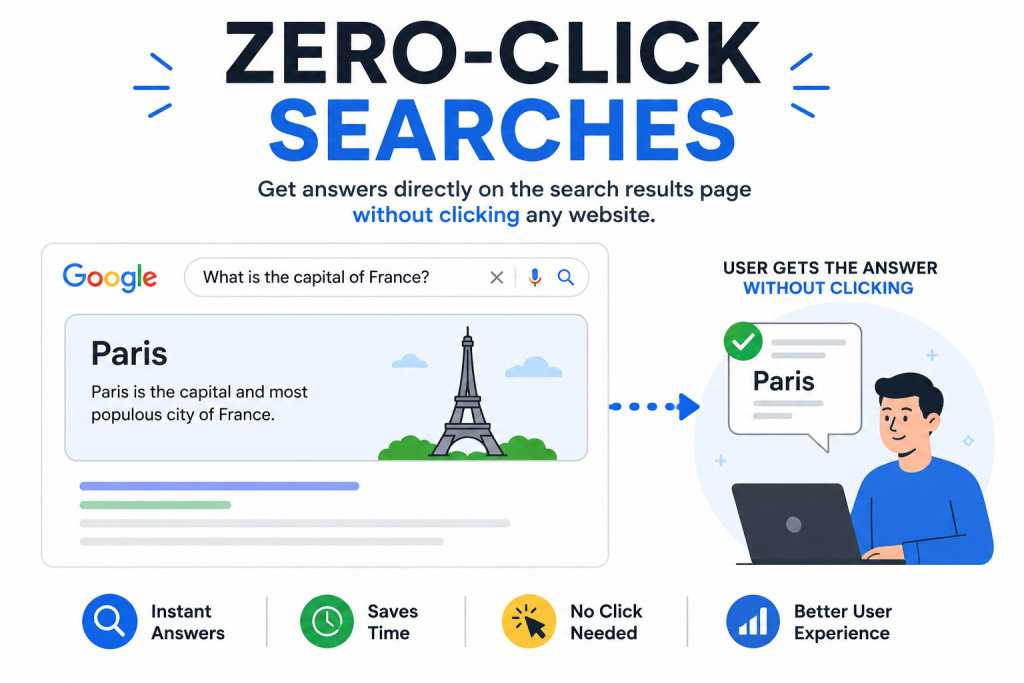
A zero-click search occurs when a user performs a search query on Google and receives the information they need directly on the search results page without clicking on any website.
For example, if someone searches “What is digital marketing?” Google may display a definition at the top of the results. If a user searches for weather updates, sports scores, currency conversions, or business hours, the answer is often provided instantly.
Google achieves this through several SERP features, including:
- AI Overviews
- Featured Snippets
- Knowledge Panels
- Local Packs
- People Also Ask Sections
- Direct Answer Boxes
- Maps and Business Listings
These features improve user experience by reducing the time required to find information. However, they also reduce the number of clicks many websites receive from informational searches.
As Google continues investing in artificial intelligence and search enhancements, zero-click searches are becoming more common across almost every industry.
Why Are Zero-Click Searches Increasing?
The growth of zero-click searches is largely driven by Google’s mission to provide the fastest and most accurate answers possible.
In the past, users had to visit multiple websites to gather information. Today, Google aims to provide those answers directly within the search results page.
The introduction of Google AI Overviews has accelerated this trend. AI Overviews use artificial intelligence to summarize information from multiple sources and present it in a concise format at the top of search results. Instead of browsing several websites, users can often find everything they need within Google’s interface.
User behavior is another major factor. Modern internet users expect convenience and speed. When an answer is immediately available, many people choose not to click through to another page.
This change doesn’t mean websites are becoming less important. In fact, Google still relies on high-quality content from websites to generate answers. The difference is that brands must now optimize not only for clicks but also for visibility within Google’s evolving search ecosystem.
How Zero-Click Searches Impact SEO
For many businesses, the biggest concern is a decline in organic traffic.
Informational keywords that once generated thousands of website visits may now produce fewer clicks because Google provides answers directly on the results page. This is particularly common for simple questions, definitions, and factual queries.
However, focusing solely on traffic can be misleading.
A website may receive fewer clicks while simultaneously gaining greater visibility. If your content is featured in AI Overviews, Featured Snippets, or People Also Ask sections, your brand can appear in front of thousands of users who may not have discovered you otherwise.
This visibility contributes to brand awareness, credibility, and trust. Users who repeatedly see your brand cited as a source are more likely to remember it and return later when they need products or services.
Modern SEO is no longer just about rankings and traffic. It is increasingly about becoming a trusted source of information.
Why SEO Still Matters in the Age of AI Search
Some marketers have claimed that AI search and zero-click searches signal the end of SEO. In reality, the opposite is true.
Google’s AI systems still need authoritative content to generate responses. Search engines continue relying on websites to provide accurate, valuable, and up-to-date information.
The businesses that create high-quality content are more likely to be referenced in AI-generated answers and featured search results.
SEO remains essential because it helps search engines understand:
- What your content is about
- Why it is relevant
- Whether it is trustworthy
- How it compares to competing content
Without SEO, your content is less likely to appear in AI Overviews, Featured Snippets, or traditional search results.
The goal has shifted from simply earning clicks to becoming a recognized authority within your niche.
Create Content That Provides Unique Value
One of the most effective ways to compete in a zero-click environment is by publishing content that goes beyond generic information.
Many articles online simply repeat what has already been said elsewhere. This type of content is easy for AI systems to summarize because it offers little unique value.
To stand out, businesses should focus on creating original content that cannot easily be replicated.
Examples include:
- Industry research
- Customer case studies
- Expert interviews
- Survey findings
- Proprietary data
- Personal experiences
- In-depth analysis
Imagine two articles about local SEO. One provides general advice available everywhere online. The other includes real campaign results, performance metrics, and lessons learned from actual clients. The second article offers significantly more value and is more likely to earn trust, backlinks, and user engagement.
When users recognize that your content contains unique insights, they have a stronger reason to click through and explore further.
Optimize for Google AI Overviews
Google AI Overviews are becoming one of the most important visibility opportunities in search.
These AI-generated summaries often appear above traditional organic results and can dramatically influence user behavior.
To improve your chances of being featured, structure your content clearly and answer user questions directly.
Effective strategies include:
- Using descriptive headings
- Writing concise explanations
- Addressing common questions
- Including supporting statistics
- Demonstrating expertise
- Covering topics comprehensively
Google favors content that is easy to understand and provides complete answers to user queries.
By creating detailed, well-structured content, you increase the likelihood of being referenced in AI-generated search experiences.
Focus on Search Intent Rather Than Traffic Volume
One of the biggest SEO mistakes businesses make is targeting keywords based solely on search volume.
While informational keywords often attract large audiences, they are also the most vulnerable to zero-click searches.
Instead, focus on understanding user intent.
Consider the difference between these searches:
- What is SEO?
- Best SEO agency in Pune
- SEO services for ecommerce websites
- Digital marketing company for startups
The first query can often be answered directly by Google. The others indicate a user who is actively researching solutions and is more likely to visit websites.
Targeting commercial and transactional keywords helps attract visitors who are closer to making purchasing decisions.
These users are often more valuable than visitors who simply want quick information.
Use Structured Data to Improve Search Visibility
Structured data, also known as schema markup, helps search engines understand your content more effectively.
Schema provides additional context about your pages and can improve how your content appears in search results.
Common schema types include:
- FAQ Schema
- Article Schema
- Organization Schema
- Review Schema
- Product Schema
While schema does not directly improve rankings, it can increase your chances of appearing in rich results and featured search experiences.
As AI-powered search becomes more sophisticated, structured data plays an increasingly important role in helping search engines interpret and present content accurately.
Build Brand Authority Beyond Google
In a world where search behavior is constantly changing, businesses should avoid relying exclusively on Google traffic.
Building a recognizable brand creates resilience against algorithm updates and shifting search trends.
Strong brands attract visitors through multiple channels, including:
- Email marketing
- Social media
- YouTube
- Podcasts
- Communities
- Referral traffic
- Direct searches
When users actively search for your brand name, you become less dependent on generic search queries.
The most successful companies understand that SEO should support broader brand-building efforts rather than operate in isolation.
The Future of SEO and Zero-Click Searches
The future of search will likely involve even more AI-driven experiences.
Search engines will continue providing faster answers, personalized recommendations, and conversational interactions. As a result, businesses must adapt their strategies to remain visible and competitive.
The brands that succeed will be those that focus on expertise, originality, and trust.
Rather than chasing rankings alone, they will create content that genuinely helps users, answers important questions, and demonstrates real-world knowledge.
In this environment, authority becomes a competitive advantage.
The businesses that establish themselves as trusted industry leaders will continue earning visibility, whether users click immediately or not.
Final Thoughts
Zero-click searches are transforming the way users interact with search engines. While they may reduce traditional organic clicks for some queries, they also create new opportunities for visibility and brand recognition.
Businesses that continue producing generic content may struggle to maintain traffic as Google becomes better at delivering instant answers. However, organizations that focus on expertise, original insights, user intent, and strong brand building can thrive in this evolving landscape.
The future of SEO is not just about attracting clicks. It is about becoming the source that search engines trust, AI systems reference, and users remember.
As Google AI Overviews and zero-click searches become more common, the brands that prioritize value, authority, and user experience will remain visible, relevant, and successful in the years ahead.